Both VPS and VDS give you a private Linux server with root access, but they work differently under the hood. Here's how to choose.
VPS: Virtual Private Server
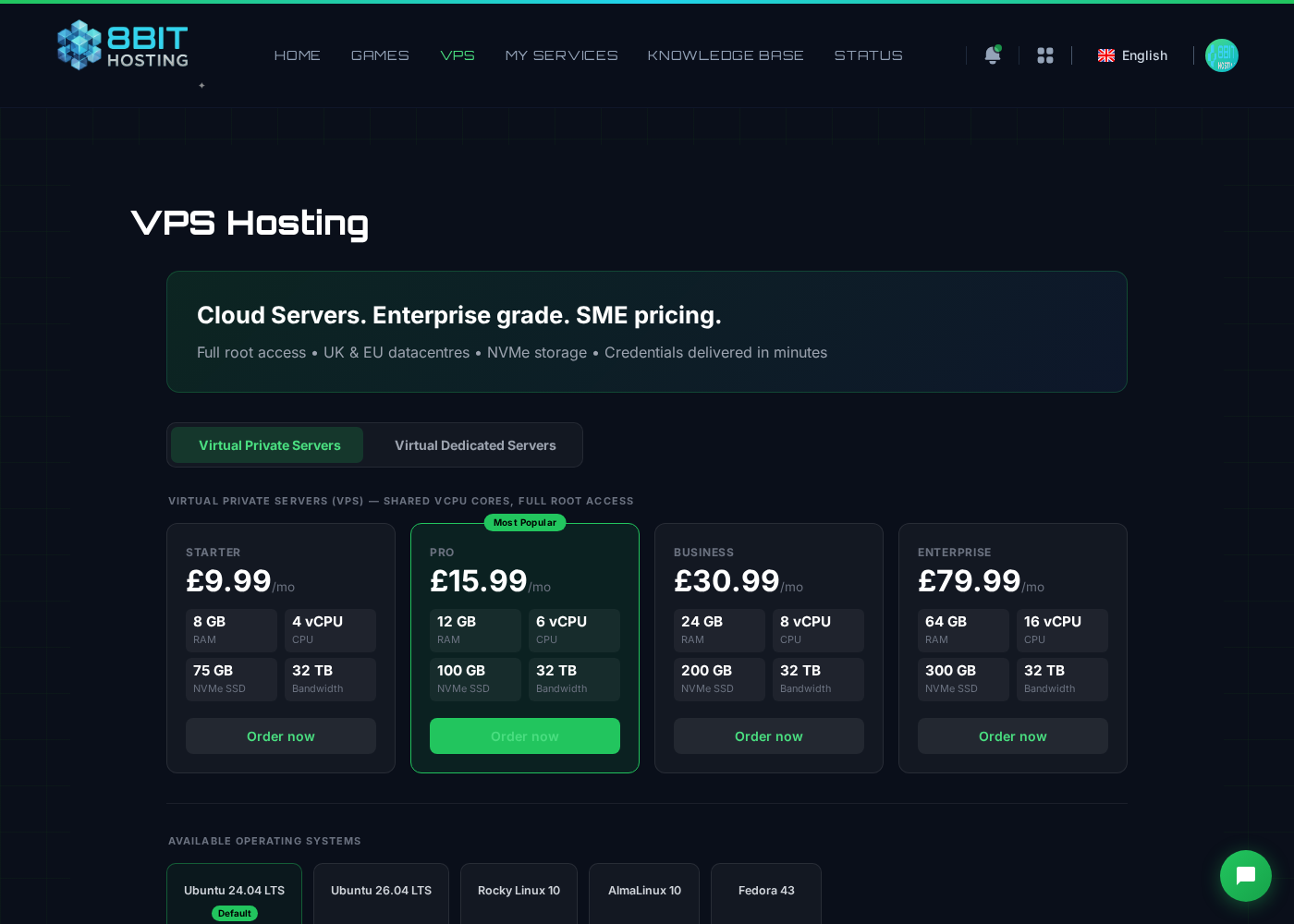
A VPS runs inside a hypervisor alongside other virtual machines on the same physical host. Your vCPU cores and RAM are allocated to you and guaranteed, but the underlying physical CPU is shared between VMs.
- Best for: websites, Discord bots, small game servers, development environments, hosting apps
- Starting from: £9.99/mo
- Full root access, choice of Linux OS
- NVMe SSD storage, UK & EU locations
VDS: Virtual Dedicated Server
A VDS gives you dedicated physical CPU cores that are not shared with any other customer. This means near bare-metal performance with none of the "noisy neighbour" problems you can sometimes get on a shared hypervisor.
- Best for: high-traffic websites, large game networks, databases, applications needing consistent CPU performance
- Starting from: £119.99/mo
- Dedicated physical cores, up to 8 cores and 64 GB RAM
- Full root access, choice of Linux OS
Quick comparison
| Feature | VPS | VDS |
|---|---|---|
| CPU | Shared hypervisor, guaranteed vCores | Dedicated physical cores |
| RAM | Guaranteed allocation | Guaranteed allocation |
| Performance | Excellent for most workloads | Near bare-metal |
| Starting price | £9.99/mo | £119.99/mo |
| Root access | Yes | Yes |
| OS choice | Yes | Yes |
Not sure which to pick? Start with a VPS. You can always open a support ticket if you want to discuss upgrading to a VDS.
 8Bit Hosting